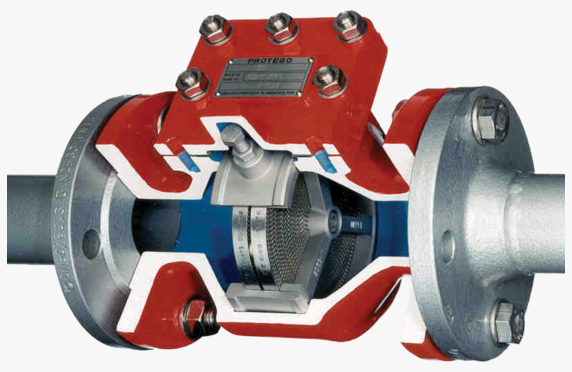
What is a Flame Arrester?
A flame arrester (eng. flame arrester) itself cannot prevent ignition from occurring, but when properly selected and installed, it can prevent the flame from entering parts of the piping where it is not wanted. The device’s nickname, flame trap, is quite descriptive.
Gases are the typical medium for a flame arrester, as they are not intended for liquids. Although an ignition-sensitive liquid may be present in the process, the flame arrester itself is installed in a location where the liquid has vaporized.
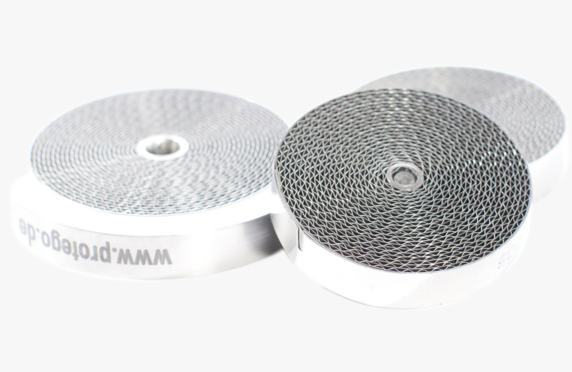
Functionally, a flame arrester works like a reverse heat exchanger – it absorbs the energy required for combustion from the flame while continuously permitting the gas flow.
Selecting a Flame Arrester
We assist in selecting a flame arrester that meets the requirements of the application. We emphasize technical arguments in choosing flame arresters. It is important to understand the process, identify potential ignition sources, recognize the process gases and their explosion classes that are prone to ignition, and install properly sized and appropriately selected flame arresters in the correct locations. Keep in mind that if the flame arrester does not stop the flame, it is essentially useless and only creates a false sense of security. Conversely, an overly dense flame arrester produces an unnecessarily high pressure drop on the normal gas flow, even though it stops the flame.
Related to this topic is our video on deflagration flame arresters with detonation flames. On one hand, it shows how a flame passes through a wrongly selected flame arrester, but on the other, it gives an idea of the flame’s power.
Maintainability as a Selection Argument
The flame arresting element itself functions much like a dense sieve and, depending on the purity of the process medium, can become contaminated and clogged rather quickly.
Our service team is happy to assist with the cleaning of flame arresters as well as provide consulting and planning for an appropriate maintenance interval.
Similarly, our sales team offers design support for device selection. The German company Protego, which we represent, is a well-respected device manufacturer focused specifically on producing flame arresters and breathing valves for tanks. Their strength lies in product development and equipment testing. The devices do not need to be modeled, as actual process media, flows, and pressures can be used for testing in the factory’s test areas. In safety-approved testing conditions, it is acceptable to push the limits. We are happy to arrange familiarization trips to Protego’s factory in Braunschweig, Germany, for our customers.
In this test, it was examined whether an overpressure valve functions as a flame arrester.
Well, it didn’t work. This brings us to the over-/underpressure valves of tanks, i.e. the breathing valves of large tank containers. If we have a flammable gas mixture, the risk analysis must take into account that it can ignite and, as the video above on an overpressure valve functioning as a flame arrester shows, the valve itself does not prevent the flame from entering the tank.
For this purpose, Protego offers a wide range of over-/underpressure valves integrated with flame arresters.
There are also special models for extremely cold and viscous conditions, such as a diaphragm-type over-/underpressure valve for tank containers with flame arrester functionality.